Why does a metal spoon feel colder than a wooden one, even if they are in the same room? The answer lies in the thermal conductivity of each material.
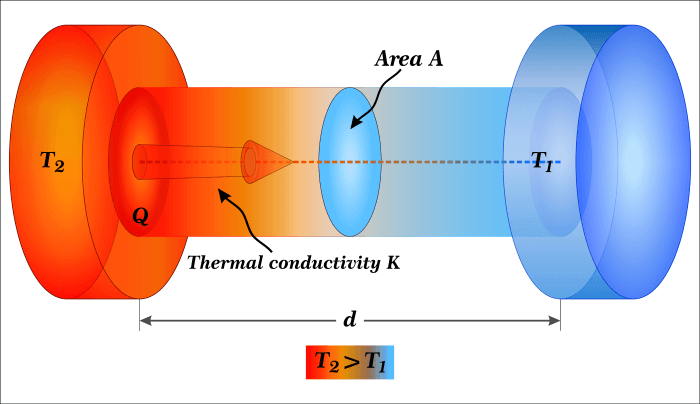
Thermal conductivity is a property that describes how well a material conducts heat. There are three main types of heat transfer: conduction, which occurs through direct contact; convection, which occurs through fluid movement; and radiation, which occurs through electromagnetic waves such as light. Thermal conductivity specifically describes heat transfer through conduction.
Measuring how easily heat flows
In simple terms, thermal conductivity measures how easily heat can flow through a material. Heat moves through a material with high thermal conductivity more quickly than it moves through a material with low thermal conductivity.
Thermal conductivity is measured in watts per meter-kelvin, written as W/m·K. More precisely, a material with a thermal conductivity of 1 W/m·K allows one watt of heat to flow through a one-meter-thick slab with a surface area of one square meter when there is a temperature difference of one kelvin across it.
Metals are examples of materials with high thermal conductivity, while wood and foam are examples of materials with low thermal conductivity.
What happens at the microscopic level
At the microscopic level, thermal conductivity depends on how energy moves between particles. Metals have high thermal conductivity partly because their free electrons can transport energy easily. Materials with low thermal conductivity transfer more heat through vibrations of atoms, which can be less efficient.
Thermal conductivity in daily life
Cooking pots and pans are made of metal to move heat quickly from the stove to food. In contrast, double-paned windows slow heat from escaping a house because the layer of air between the panes acts as an insulator.
Thermal conductivity plays a role in everything from heat safety to electronics and energy efficiency. It may seem like a small detail, but it significantly influences how we interact with energy and the world around us.