Thermogravimetric
analysis.
TGA uses a super sensitive balance to measure changes in mass (weight) of a material while it follows a controlled temperature program.
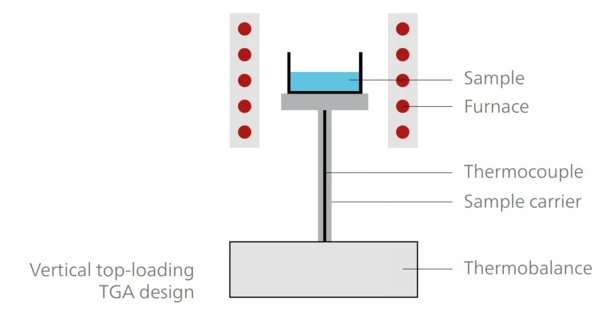
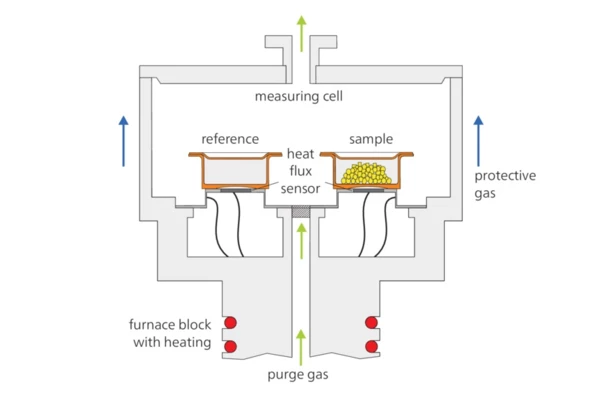
TGA combines a balance and a furnace.
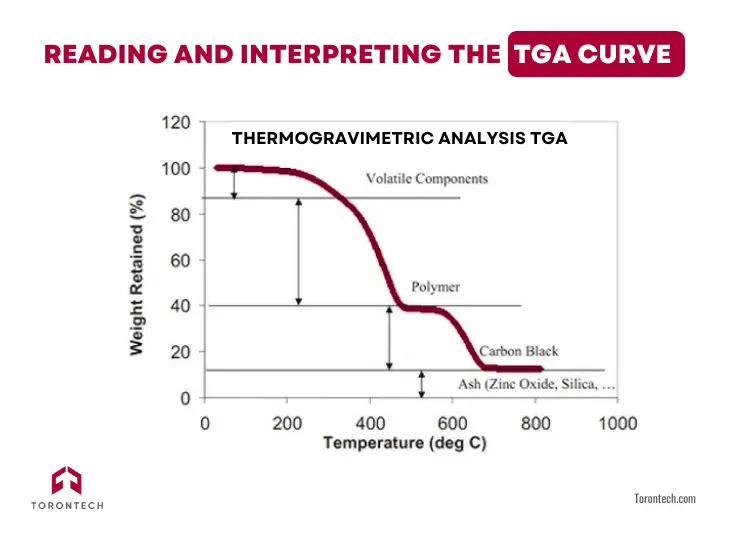
A small, carefully weighed sample, typically weighing between 1-20 milligrams, is placed on a sensitive balance inside a heated chamber. As the temperature increases at a constant rate, the instrument continuously records how much mass remains. Temperatures often reach 1000 degrees Celsius or higher. The resulting mass and temperature data produce a mass-versus-temperature curve (a.k.a. a thermogram).
A drop in mass can be due to a variety of causes, such as moisture leaving, a polymer decomposing, or carbon burning away. Conversely, a mass increase can also happen when a material reacts with oxygen in the hot environment and forms a heavier oxide. TGA can also measure the thermal stability of a material, or the precise temperature threshold where a material begins to degrade.
Inside the chamber, different gases can be injected to study different properties of the material. For example, inert gas such as argon helps study decomposition, while reactive gases like air can reveal oxidation or combustion. TGA shows that mass changes, but another method may be needed to identify what escaped or remained.
See all lab guides ↗